Monitor Quartz Crystals for Thin Film Deposition
Monitor quartz crystals provide precise real-time measurement of thin-film deposition during evaporation, sputtering, and other vacuum coating processes. Designed for Quartz Crystal Microbalance (QCM) systems, these high-quality AT-cut quartz crystals are available in 5 MHz and 6 MHz frequencies with gold, silver, alloy, or blank electrode configurations. UniversityWafer supplies monitor quartz crystals for semiconductor manufacturing, optical coatings, research laboratories, and advanced materials development.
Precision Monitor Quartz Crystals for Thin Film Deposition
UniversityWafer supplies premium monitor quartz crystals for accurate thin-film thickness measurement during vacuum deposition processes. Our high-quality AT-cut quartz crystals are designed for use in Quartz Crystal Microbalance (QCM) systems and are trusted by universities, semiconductor manufacturers, optical coating companies, and research laboratories worldwide for reliable deposition monitoring and process control.
Recent Research Inquiry
"We are depositing alternating dielectric thin films using an electron beam evaporation system and require 6 MHz AT-cut monitor quartz crystals with gold electrodes for real-time thickness monitoring and precise deposition rate control."
Reference #214973
Available Monitor Quartz Crystal Specifications
- 5 MHz and 6 MHz operating frequencies
- AT-cut precision quartz crystals
- Gold, silver, alloy, or blank electrodes
- 12.45 mm and 13.97 mm diameters
- High frequency stability
- Compatible with most QCM controllers
- Ideal for evaporation and sputtering systems
- Research Grade and production quantities available
Get Your Monitor Quartz Crystal Quote FAST! Or
Buy Online
and Start Researching Today!
What Are Monitor Quartz Crystals?
Monitor quartz crystals are precision AT-cut quartz resonators used in
Quartz Crystal Microbalance (QCM) systems to measure thin-film growth
during vacuum deposition. As material is deposited onto the crystal surface, its
resonant frequency changes proportionally to the mass of the deposited film. This
enables real-time monitoring of deposition rate and total film thickness with
exceptional accuracy, helping researchers and manufacturers maintain precise process
control throughout the coating cycle.
How Quartz Crystal Monitoring Works
A monitor quartz crystal is mounted inside the deposition chamber where it experiences
the same coating environment as the production substrate. The QCM controller measures
tiny frequency shifts as material accumulates on the crystal. Using the
Sauerbrey equation, the instrument converts these frequency changes into deposited
mass and film thickness, allowing operators to start, adjust, or stop the deposition
process at the desired thickness.
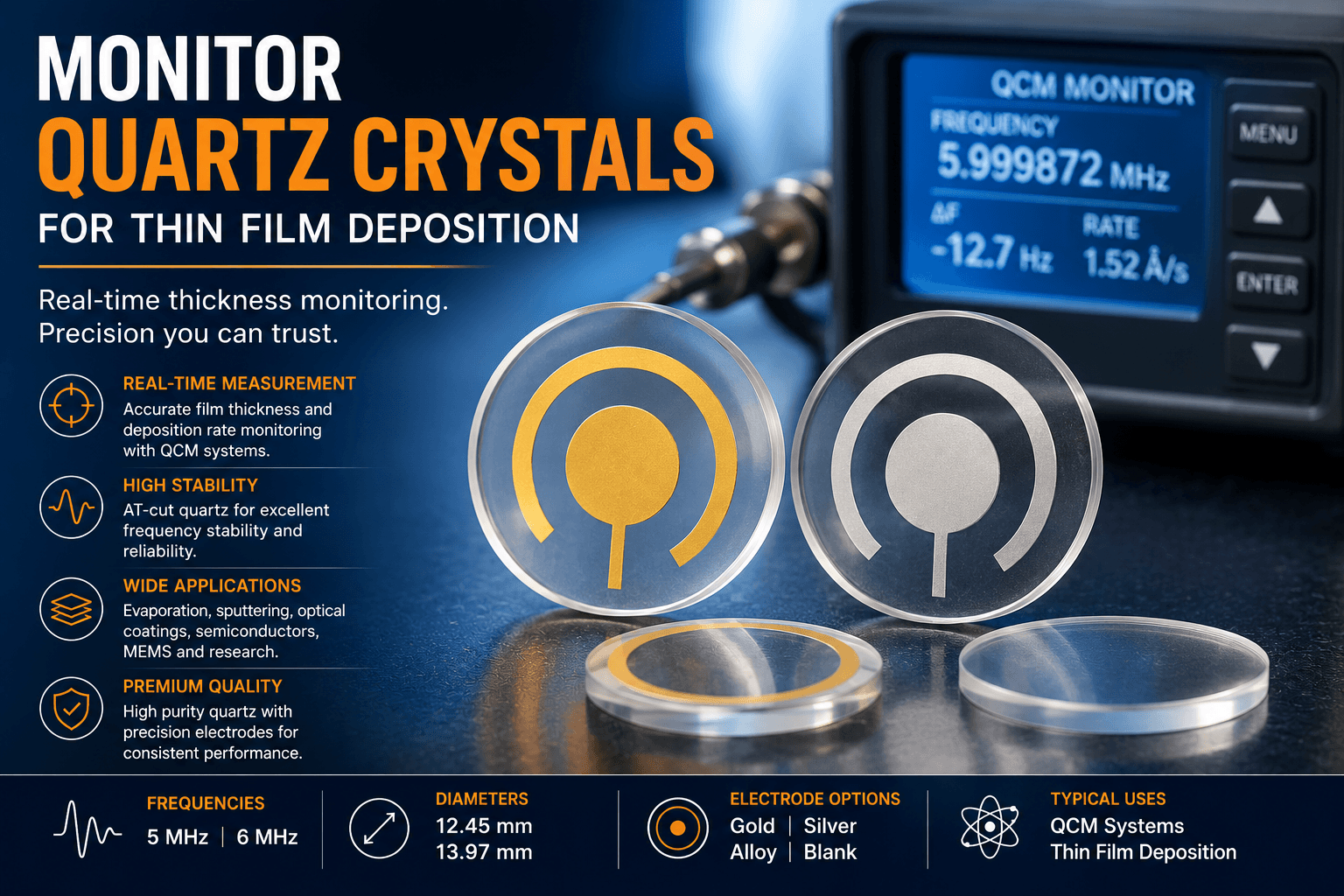
Features and Specifications
UniversityWafer supplies monitor quartz crystals in industry-standard
5 MHz and 6 MHz frequencies with
gold, silver, alloy, or
blank electrode configurations. Available in common diameters such
as 12.45 mm and 13.97 mm, these precision crystals provide excellent frequency
stability, repeatability, and compatibility with many commercial QCM monitoring
systems used in research and production environments.
Applications of Monitor Quartz Crystals
Quartz monitor crystals are essential in industries where precise film thickness
control directly impacts device performance. Common applications include:
- Physical Vapor Deposition (PVD)
- Thermal and electron-beam evaporation
- Magnetron sputtering
- Optical coating deposition
- Semiconductor manufacturing
- MEMS and sensor fabrication
- Solar cell and photovoltaic coatings
- University and government research laboratories
Why Choose UniversityWafer?
UniversityWafer provides high-quality monitor quartz crystals manufactured for
consistent resonance, low frequency drift, and reliable deposition measurements.
Whether you require small research quantities or production volumes, our crystals
deliver the accuracy needed for semiconductor fabrication, optical coatings,
nanotechnology, advanced materials research, and precision thin-film process
development.
Related Internal Links
